Call Us:
(800) 362-3097
How to Choose a Forklift: Total Cost vs. Purchase Price
May 21, 2026
When it’s time to add or replace forklifts in your operation, it’s tempting to go straight to the bottom line on a quote. But if upfront price is the only number you’re comparing, you may be setting yourself up for higher costs down the road – and a lot more headaches along the way.
Upfront Price vs. Long-Term Value
Price is what you pay. Value is what you get. These aren’t the same thing. In the material handling world, the gap between them can be significant over the life of a piece of equipment.
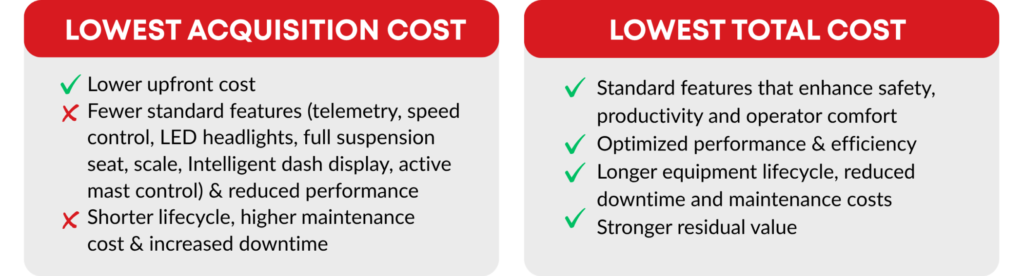
Lower acquisition cost options often come with trade-offs: fewer standard safety features, shorter equipment lifecycles, higher maintenance frequency, and increased downtime. A truck that costs less to buy may end up costing far more per operating hour over its lifetime, which is the number that actually matters.
Total Lifecycle Spend: The Real Metric
According to the Material Handling Institute (MHI), total cost of ownership – not purchase price – is the standard benchmark for evaluating industrial equipment. In material handling, what matters is how many lifetime operating hours a truck can be economically used, measured as cost per hour (CPH), and how that translates into years of service.
When you plot maintenance costs over 20,000+ operating hours, the difference between a premium-built truck and a budget alternative becomes clear. The gap starts small but compounds over time. By the time a lower-cost truck needs replacing, a well-built alternative is often still running efficiently — at a lower cost per hour.
When Comparing Quotes, Ask the Right Questions
If specifications differ, price comparisons are misleading. Before you make a decision based on quote sheets alone, make sure you’re comparing apples to apples. Here are the questions worth asking every vendor:
- What warranty coverage is included?
- Are the equipment specs comparable?
- What are the charging requirements?
- What is the expected lifespan?
- Are usage assumptions consistent?
- Is the residual value guaranteed?
- What does the payment structure look like?
- What features are included?
- Is there service response time guarantee?
- Number of technicians covering my area?
- What is the first time fix rate?
What Sets a Great Forklift Partner Apart
- Industry-Leading Equipment: Toyota reliability since 1956, longer operating life, and lower cost per hour to operate. Most models are manufactured in the US.
- Expert Local Service & Support: Responsive local Toyota certified and trained technicians who know your operation & protect your uptime with nearly 90% same day repairs and provide two-year warranties on most repairs.
- MyInsights Telematics: Telemetry is standard equipment on most Toyota models provides data-driven visibility to improve utilization, accountability, resulting in fewer PM’s & reduced operating costs.
- Lean-Driven Processes: Standardized internal processes that reduce waste, improve efficiency, and result in lower repair costs.
- Continuous Improvement: A commitment to getting better every year – and Fleet Management plans available so your operation does too.
The Bottom Line
The goal of any equipment purchase shouldn’t be to spend the least today, it should be to spend the least over the life of the equipment while keeping your operation running safely and efficiently.
That’s the difference between lowest acquisition cost and lowest total cost. It’s not just a sales pitch – it’s how the math works out when you look at the full picture.
Ready to Run the Numbers on Your Fleet?
Lift Truck Center has been delivering trusted material handling solutions for over 40 years. We’re happy to walk through a total cost comparison for your operation.
Categories